Fraud targeting older Americans has become a major public-safety problem.
According to the FBI's 2025 Internet Crime Report, Americans over the age of 60 reported approximately $7.7 billion in losses in 2025, a 37% increase from the previous year.
For sheriff's offices, police departments, 911 centers, aging agencies, and local governments, those numbers raise an important question:
What can communities do to stop a scam before a resident sends the money?
For years, much of senior scam prevention has focused on education. Agencies hold community meetings, publish scam alerts on social media, distribute flyers, and remind residents not to give personal information to strangers.
Those efforts remain important.
But there is another opportunity for local law enforcement: giving residents a simple way to interrupt the scam while it is happening.
Why Senior Scams Are So Difficult to Stop
Modern scammers don't simply ask for money.
They manufacture urgency.
A resident may receive a call claiming to be from law enforcement, a government agency, a bank, a utility company, or even a family member.
The details change, but the pressure is often similar:
- You owe money immediately.
- Your bank account has been compromised.
- A warrant has been issued.
- Your grandchild is in trouble.
- Your identity has been stolen.
- Your money needs to be moved somewhere "safe."
- You cannot tell anyone what is happening.
The Federal Trade Commission has documented a particularly concerning increase in government and business impersonation scams targeting older adults. Reports from adults 60 and older who lost $10,000 or more to these scams increased more than fourfold between 2020 and 2024.
For losses exceeding $100,000, the increase was even more dramatic.
In 2024, 41% of older adults reporting losses of $10,000 or more to government or business impersonation scams said the scam began with a phone call.
The scammer's goal is often to keep the victim isolated long enough to complete the transaction.
That creates a small but critical window for intervention.
The Most Important Moment May Be Before the Money Moves
When a resident realizes they've been scammed, they may call their bank or local law enforcement.
Unfortunately, by then the money may already be gone.
A deputy or officer takes the report, documents what happened, identifies the scam method, and attempts to help the victim.
But what if local law enforcement could move further upstream?
Imagine a resident is on the phone with someone claiming to be a deputy.
The caller says there is a warrant for the resident's arrest and demands immediate payment.
The resident becomes frightened and reaches for a debit card.
That moment — before the payment is made — is where scam prevention can become scam interruption.
The goal is simple:
Pause. Hang up. Verify.
The FTC specifically recommends that consumers who receive unexpected demands for money stop and verify the story independently using contact information they know is legitimate.
For communities, creating that pause may prevent thousands of dollars from ever leaving a resident's account.
How Sheriff's Offices and Police Departments Can Help Interrupt Scams
Local law enforcement has something scammers desperately try to imitate: trust.
Scammers pretend to be deputies, police officers, federal agents, bank representatives, and government officials because those identities carry authority.
That same local trust can be turned against the scammer.
A community scam-interruption program can give residents a clear instruction:
Before money moves, stop and contact a trusted local source.
That's the idea behind PauseOk.
What Is PauseOk?
PauseOk is a scam-interruption program from ConfirmOk designed for sheriff's offices, police departments, and other public-safety partners.
Rather than waiting for residents to report a scam after losing money, PauseOk gives them a simple action to take while the scam is happening:
Pause, hang up, and call.
The program combines three components.
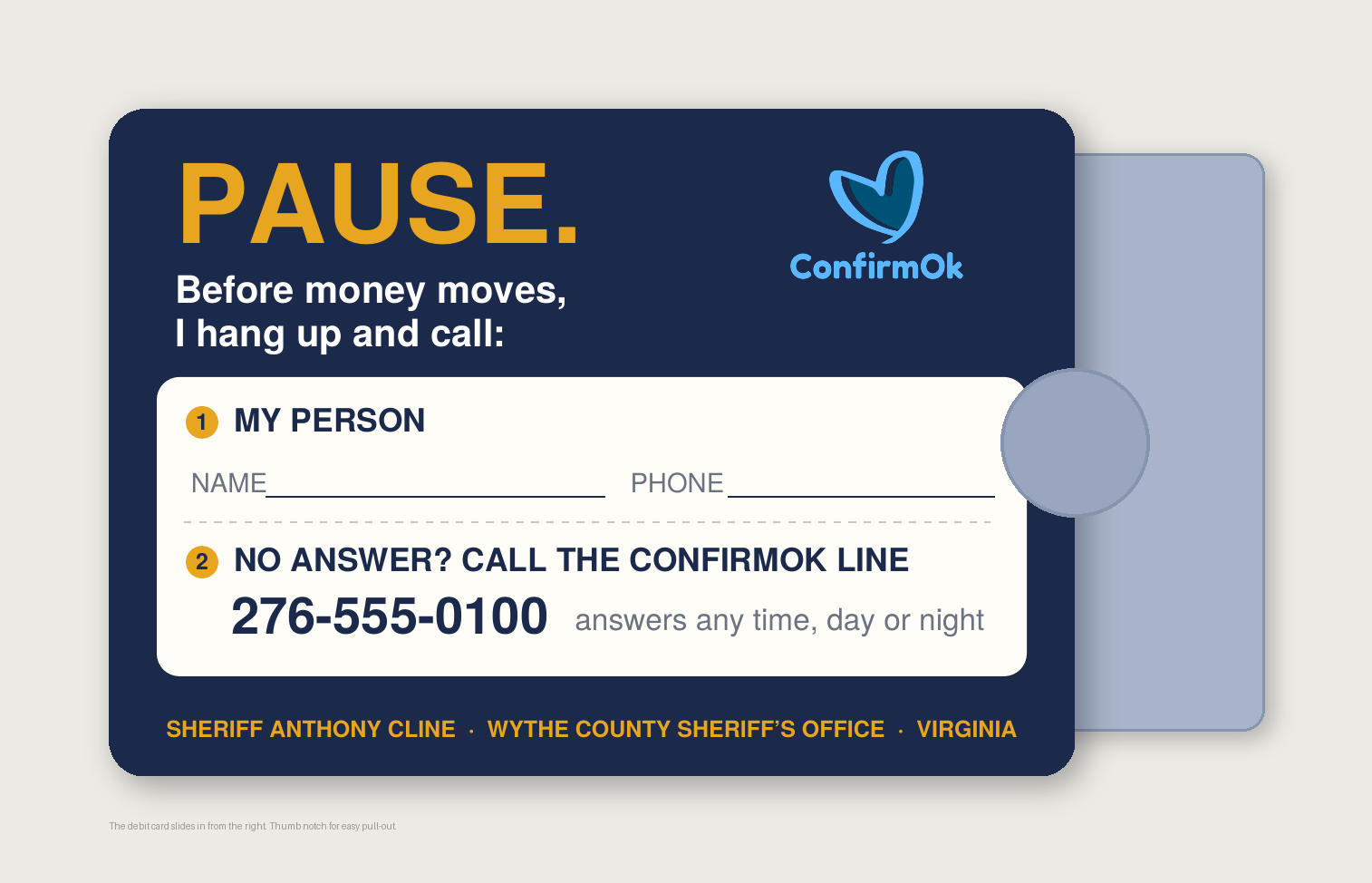
1. A PAUSE Card Sleeve
Residents receive a county- or agency-branded sleeve that holds their debit or credit card.
The sleeve carries a simple reminder:
Before money moves, I hang up and call.
The idea is to put the warning at the exact point where many scams turn into financial loss.
Instead of hoping a resident remembers something from a fraud presentation six months earlier, the reminder appears when they're physically reaching for their card.
2. A 24/7 Local Scam-Interruption Line
Residents can call a dedicated local number at any time.
The line can answer in the sheriff's or police chief's recorded voice, reinforcing that the resident did the right thing by stopping.
The caller hears straightforward warnings about common scam tactics and can leave a statement describing what happened.
If there is an emergency or immediate danger, callers are instructed to hang up and call 911.
The PauseOk line is not an emergency line. It is designed specifically to create a trusted interruption between a scammer's demand and a resident sending money.
3. Local Scam Intelligence
Calls to the program can become useful information for the participating agency.
Departments can review recordings and transcripts, classify scam types, document potential losses, and identify patterns affecting residents.
Instead of seeing individual scam reports only after losses occur, agencies can begin developing a clearer picture of what scammers are attempting in their communities.
A department might discover, for example, that multiple residents received the same fake warrant call during the same week.
That information can then inform community alerts, social-media posts, senior-center presentations, and other outreach.
From Scam Reports to Scam Intelligence
This is an important shift for local government.
Traditional reporting tells an agency:
What happened?
Scam-interruption programs can also help answer:
What is happening right now?
That can give public-safety agencies a better understanding of which scams are circulating locally, what stories scammers are using, how residents are being contacted, and how much money residents were being asked to send.
That information can make community education more timely.
Instead of posting a generic warning about scams, a sheriff's office might be able to tell residents:
"Several residents have reported callers impersonating deputies this week and demanding payment for missed jury duty."
That is a much more actionable warning.
Education Still Matters — But Timing Matters Too
Community education should remain an important part of elder fraud prevention.
Senior centers, law enforcement agencies, aging organizations, financial institutions, caregivers, and families all play a role in helping older adults recognize scams.
But scammers deliberately create situations where victims don't have much time to think.
That's why an effective prevention strategy should combine education with interruption.
Teach residents what scams look like.
Give them something that reminds them to pause.
Provide a trusted place to verify what is happening.
And make that resource available when the scam actually occurs — including nights, weekends, and holidays.
A New Role for Local Law Enforcement in Elder Fraud Prevention
Local law enforcement cannot prevent every fraudulent phone call, text message, email, or social-media message from reaching residents.
But communities may be able to prevent more of those contacts from becoming financial losses.
The opportunity is to move intervention earlier.
Not after the gift cards have been purchased.
Not after the cryptocurrency has been transferred.
Not after the bank account has been emptied.
Before the money moves.
For sheriff's offices, police departments, counties, cities, and aging-service organizations looking for new ways to protect older residents, scam interruption can become another layer of community safety.
PauseOk was built around that idea.
Residents get one simple instruction when something doesn't feel right:
Pause. Hang up. Call.
Learn more about PauseOk and how a local scam-interruption program can work in your community by visting confirmok.com/pauseok